
Students interact with audio technology every day through speakers, televisions, headphones, gaming systems, and smart devices. But using audio equipment is very different from understanding how sound systems actually work.
Professional AV training gives students the opportunity to explore the technology behind sound, including electrical signals, amplifiers, speakers, acoustics, cabling, and system connections.
Key Takeaway: Hands-on AV training helps students understand how sound systems work from signal source to speaker while building practical skills for certification and future careers.
Sound Starts With a Signal
Every audio system depends on a signal path.
A signal begins at a source, moves through processing and amplification equipment, and eventually reaches an output device such as a speaker. Understanding that path helps students see how each component affects system performance.
Students learn to identify:
- Where an audio signal begins
- How signals move through a system
- How processors modify sound
- How amplifiers increase signal strength
- How speakers convert electrical signals into audible sound
These concepts also provide the foundation for troubleshooting. When sound is distorted, weak, or missing, students need to know where to look and how to isolate the problem.
Understanding Speakers and Amplifiers
Speakers and amplifiers must work together correctly.
Students need to understand speaker types, power ratings, impedance, wiring requirements, and amplifier output. Incorrect equipment selection or installation can affect sound quality and may damage system components.
Hands-on training gives students a clearer understanding of how technical specifications influence real system performance.
The Marcraft STS Audio/Video Endorsement Program covers topics such as:
- Speaker power ratings
- Speaker impedance
- Speaker wire standards and practices
- Receiver and amplifier operation
- Speaker types
- Crossover speaker networks
These lessons help students move beyond memorizing definitions and begin applying technical information to real equipment.
Exploring Acoustics and Sound Quality
Good sound depends on more than the equipment being used.
Room size, surfaces, speaker placement, and sound reflections can all affect what a listener hears. A powerful audio system may still perform poorly if the surrounding environment is not considered.
Learning about acoustics helps students understand why sound behaves differently from one space to another.
Students can begin connecting technical concepts to questions such as:
- Why does sound echo in some rooms?
- Why does speaker placement matter?
- How can equalization improve sound quality?
- Why can the same equipment sound different in two locations?
This type of problem-solving is an important part of professional AV work.
Learning How Audio Components Work Together
Professional audio systems often include more than a source, amplifier, and speaker.
Signal processors, equalizers, receivers, modulators, content devices, and distribution equipment may all play a role. Students need to understand how those components connect and how one setting or connection can affect the entire system.
By following signal paths and working directly with system components, students can better understand the relationship between individual devices.
This also builds stronger troubleshooting skills because students learn to evaluate the complete system instead of focusing on only one piece of equipment.
Turning Audio Theory Into Hands-On Learning
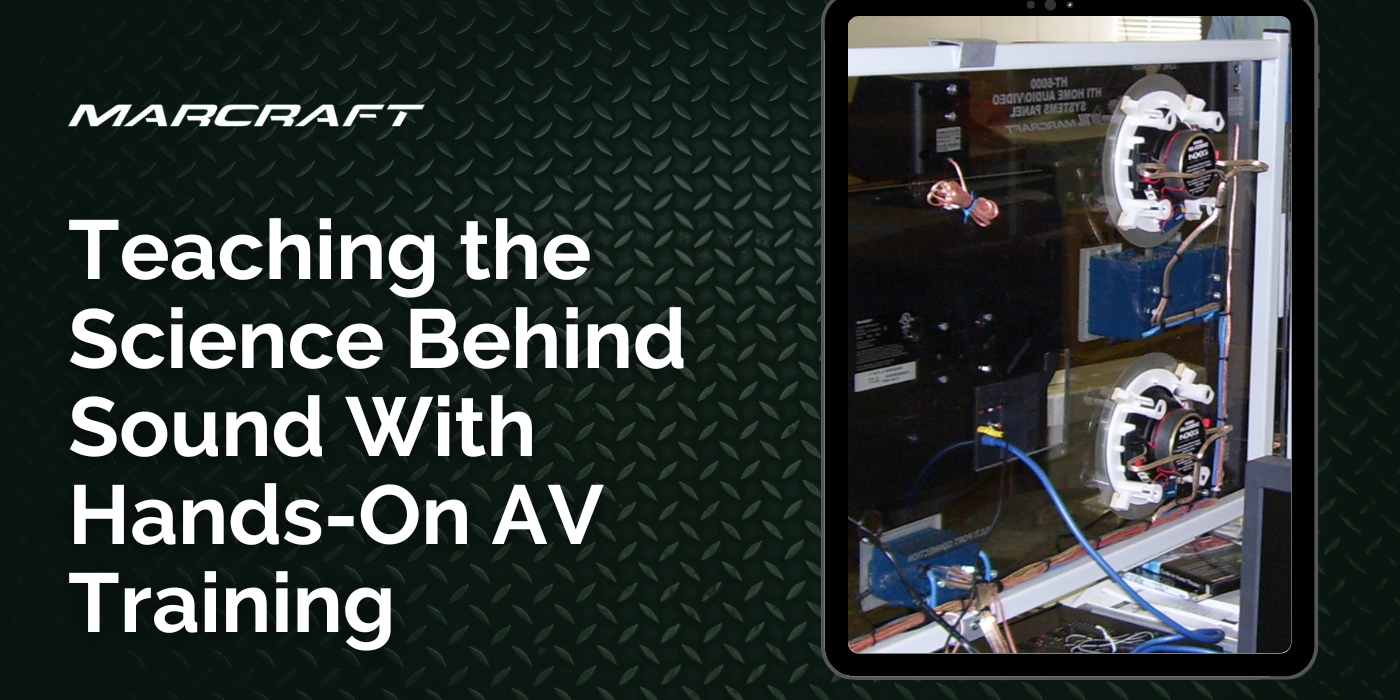
The Marcraft STS-6000 Audio-Video System Lab Panel gives students experience with real AV equipment rather than simulation alone.
Hands-on labs use equipment including:
- Speakers
- Monitors
- Audio and video cabling
- IR repeaters
- Power injectors
Students can make connections, follow signal paths, and observe how different components work together.
This practical experience helps turn technical concepts into skills students can apply in future training and workplace environments.
Preparing Students for AV Certification and Careers
The STS-6000 prepares students for the ETA Smart Technology Systems Audio-Video Endorsement and builds on the foundational training provided through the STS-1000.
The program covers audio, video, connectivity, distribution, display technology, and system integration.
These skills can support career pathways involving:
- Commercial AV installation
- Smart home technology
- Audio system integration
- Conference room systems
- Entertainment technology
- Technical support
- AV troubleshooting
Students who understand both the science and the equipment are better prepared to work with increasingly connected audio and video systems.
Building Stronger Audio Technology Skills
Professional audio training goes far beyond connecting a speaker.
Students need to understand how signals travel, how equipment interacts, and how acoustics affect performance. The Marcraft STS-6000 combines technical instruction with hands-on lab experience to help students build those skills.
By teaching the science behind sound, instructors can help prepare students for industry certification and future opportunities in audio-video and smart technology systems.